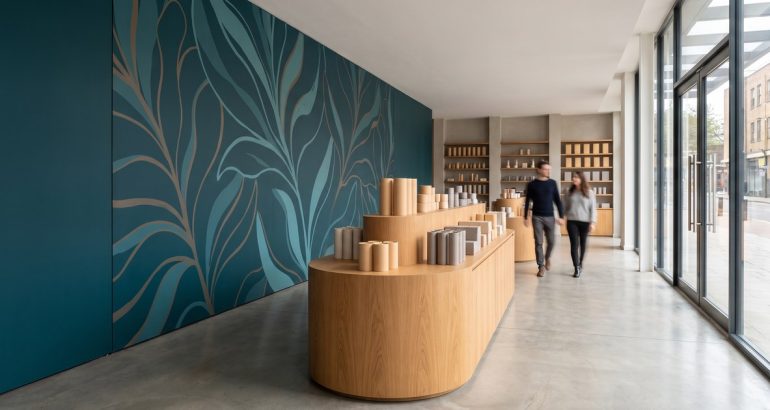
A branded environment is a physical space designed to carry a brand on every surface a visitor can see, touch, or walk past. A flagship store interior, a showroom, a pop-up, a corporate lobby, a trade show booth: the walls, signage, displays, and finishes all speak with one voice. The space stops being a neutral box and starts doing the work of a salesperson.
For brands, retailers, and property owners, a branded environment is one of the few marketing investments that works on every person who walks in, with no login and no ad auction. This guide covers what a branded environment is, why these spaces still move buying decisions, the four formats brands actually commission, and how to plan a program that holds together from the front door to the shelf.
Key Takeaways
- A branded environment is a whole physical space designed to carry a brand: retail interiors, showrooms, pop-ups, lobbies, and exhibits.
- Most buying still happens in physical space. E-commerce was 17.1 percent of total US retail sales in the second quarter of 2026, so roughly 83 percent of retail spending happened somewhere other than a screen.
- The discipline behind these spaces is established and global. The Society for Experiential Graphic Design counts about 2,200 members across 36 countries and 46 chapters.
- The four formats are retail interiors, pop-ups and activations, showrooms and corporate lobbies, and trade show exhibits, each built from signage, displays, and large-format graphics.
- A strong program moves through strategy, a space audit, design, material selection, and large-format production, sourced from as few partners as possible so color and quality hold across locations.
What Is a Branded Environment?
A branded environment is any physical space designed as a full brand expression rather than a plain room with a logo on the wall. It covers exterior storefront treatments, window and floor graphics, wall murals, backlit signage, ceiling danglers, point-of-purchase displays, and the fixtures around them. The goal is not decoration. The goal is to help a visitor understand a place quickly, feel the brand while they do it, and act.
The case for spending money on a room rather than an impression is simple arithmetic. E-commerce accounted for 17.1 percent of total United States retail sales in the second quarter of 2026, on total retail sales of $1,986.5 billion for the quarter, according to the U.S. Census Bureau. That leaves roughly 83 percent of retail spending happening in physical space, where a branded environment is the thing a customer actually experiences.
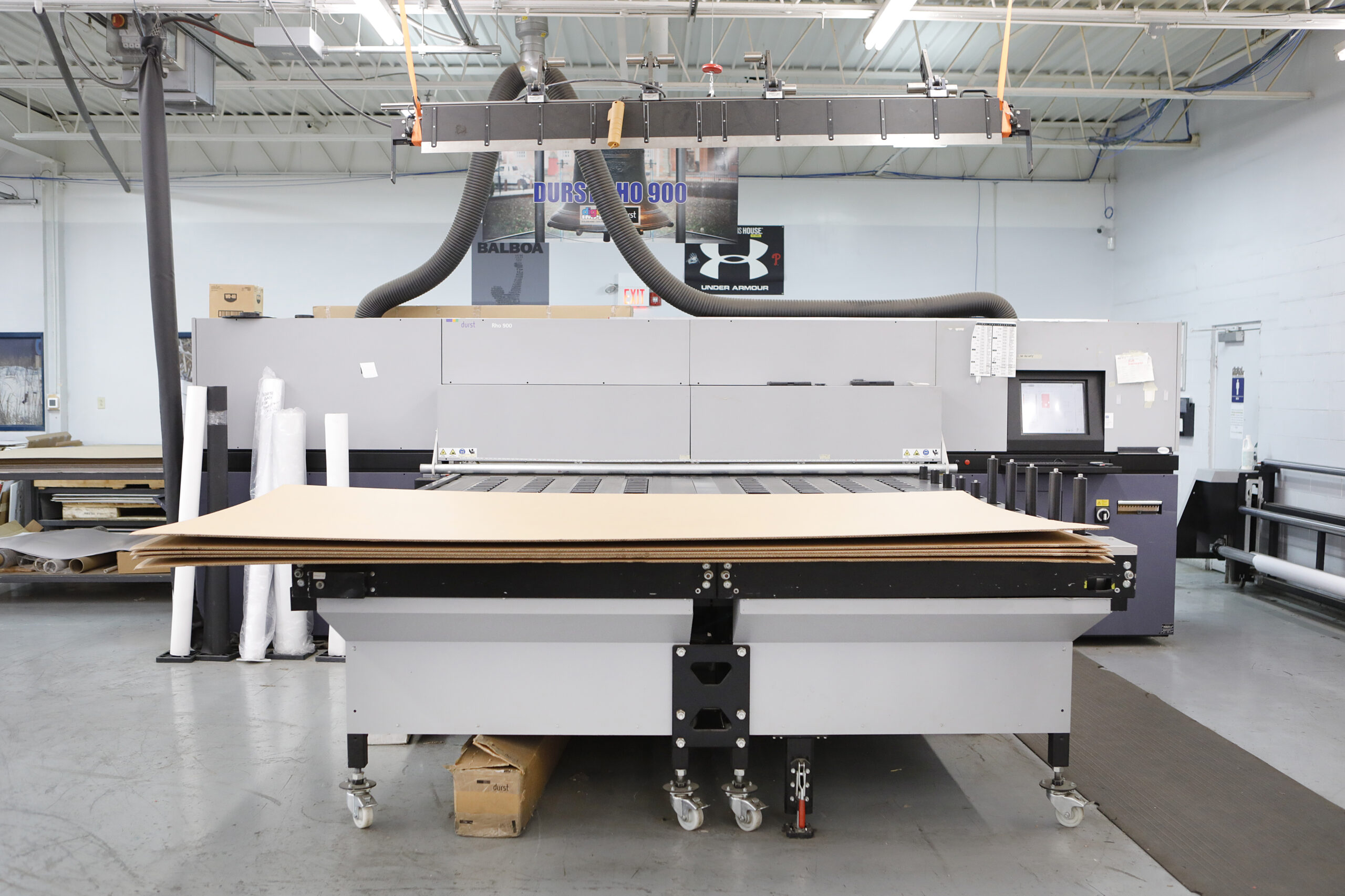
VT Group builds this work through Digital Impact, its interior and exterior signage and display manufacturer in Philadelphia, which produces point-of-purchase and point-of-sale displays, window graphics, floor graphics, wall murals and clings, backlit signage, counter displays, power wings, end caps, portable displays, and banners. A branded environment is what you get when those pieces are planned as one system instead of ordered one at a time.
Why Branded Environments Still Move Buying Decisions
Shoppers still choose the store. Heading into the 2025 holiday season, 92 percent of shoppers said they planned to spend in a physical store, led by younger generations, according to the International Council of Shopping Centers. The category is not shrinking either: total US retail sales grew 6.7 percent year over year in the second quarter of 2026, per the U.S. Census Bureau.
The reason a branded environment works is speed of judgment. Someone moving through a street, a mall, a lobby, or a show floor decides in seconds where to go and what to trust. The space is the first thing they read, before a single word of copy. A confident environment pulls attention, sets expectations, and lowers the effort of understanding what is on offer. A weak one lets the traffic a brand paid to attract walk straight past.
Where buying happens
The store is still the room where the decision gets made
Physical space carries the large majority of US retail spending, and shoppers say they intend to keep it that way.
83%
of US retail spending happened outside e-commerce in Q2 2026, on $1,986.5 billion of total sales
92%
of shoppers planned to spend in a physical store heading into the 2025 holiday season
+6.7%
year-over-year growth in total US retail sales in the second quarter of 2026
Source: U.S. Census Bureau, Q2 2026 e-commerce report; International Council of Shopping Centers, 2025 holiday shopping intentions survey
There is a compounding effect. A shopper who has already seen a brand online, then walks into a space that matches what they saw, reads one coherent company. That match is what turns recognition into a purchase. It is also why the display, the signage, and the product packaging should be treated as one connected system rather than three separate jobs.
The Four Types of Branded Environments
The discipline behind these spaces is established and worldwide. The Society for Experiential Graphic Design counts about 2,200 members across 36 countries and 46 chapters, a field that merges graphic design, exhibition design, and wayfinding to connect people to a place. In practice, that broad field narrows to four formats a brand will actually commission.
- Retail interiors. The store itself as a brand statement, from the entrance and feature walls to aisle signage, end caps, and the last few feet before checkout. This is where power wings, dump bins, counter displays, and floor graphics do their work.
- Pop-ups and activations. Temporary spaces built to launch a product, test a market, or run an event. They have to look finished, travel well, and go up fast, which puts a premium on portable displays and modular graphics.
- Showrooms and corporate lobbies. Spaces that sell to a considered buyer or set the tone for staff and visitors, using wall murals, backlit signage, and large-format graphics to make the brand feel permanent and credible.
- Trade show exhibits. Booths and regional event spaces that must read from across a crowded hall, survive repeated setup, and pack down for the next city.
Live events justify the fourth. In the second quarter of 2025, in-person trade show attendance came within 3.7 percent of pre-pandemic 2019 levels, the strongest recovery of any metric tracked in the CEIR Total Index. People still turn up in person when the space gives them a reason to.
Inside VT Group, the branded environment sits with Ocean Design Group, which turns client concepts into packaging design, branded environments, and regional events, working from structural 3D design born out of an at-shelf strategy. The retail display side is produced through VT Group’s corrugated display printing. Because the same collective develops the concept and prints the graphics, the creative intent survives the trip from sketch to store.
How to Plan a Branded Environment
A branded environment is a program, not a purchase, so it pays to run it in stages. The plan has to start with the visitor and the message, before anyone talks about substrates. A repeatable sequence keeps the budget honest and the result on brand.
- Strategy and space audit. Define what the space needs to say, to whom, and what action it should trigger. Walk the site, map traffic flow, and note every surface that can carry a message.
- Design. Develop the look, the structure, and the at-shelf concept together, so the creative and the build are solving the same problem.
- Material selection. Choose substrates and finishes for the conditions they live in, from a high-traffic retail floor to a permanent lobby feature wall.
- Large-format production. Print and die cut with color managed across every format, so a wall mural, a backlit panel, and a floor graphic all match.
- Rollout across locations. Produce every site against the same specification, so the tenth store looks like the first.
Sourcing these stages from as few partners as possible is what keeps a program from drifting. VT Group serves multinational brands, consumer products companies, converters, and Fortune 500 clients nationwide from a 45,000-square-foot facility just outside Philadelphia, which lets one team hold color and quality from design through production. The who we serve page sets out how that maps onto different sectors.
Holding Brand Consistency Across Every Location
Consistency is where most branded environment programs quietly break. The work is spread across many surfaces, vendors, and locations, and every handoff is a chance for the color to shift or the layout to wander. A shopper who sees one palette on the website, a second on the storefront, and a third on the in-store display does not read three campaigns. They read one brand that looks unsure of itself.
The fix is to design the program as a single visual system, with defined colors, type, materials, and spacing rules that every location follows. That system is easier to hold when one partner controls production, because the same color management and quality checks apply to every format. VT Group was founded in 1966 just outside Philadelphia and now runs graphic design, flexographic pre-press and plate making, large-format digital printing, die cutting, display production, and interior design build under one roof. For the element-level view of how graphics shape a space, see the VT Group guide to environmental graphics, and for the whole-room design question, commercial interior design.
Frequently Asked Questions
What is the difference between a branded environment and environmental graphics?
Environmental graphics are the individual designed elements applied to a space, such as aisle signage, wall murals, and floor graphics. A branded environment is the whole space those graphics add up to, planned as one brand expression. Environmental graphics are the parts; the branded environment is the finished room.
Are branded environments only for retail?
No. Retail interiors are a common use, but showrooms, corporate lobbies, workplaces, museums, pop-ups, and trade show exhibits are all branded environments. Any space where a visitor forms an impression of an organization is a candidate.
How long does a branded environment project take?
It depends on the size of the space, the number of locations, and the materials, so timelines are set per project rather than by a fixed rule. Running the work in stages, from strategy and design through material selection and production, is the reliable way to keep a rollout on schedule. Ask your production partner to scope the timeline against your specific site and launch date.
Do I need separate vendors for design and production?
Fewer vendors usually protect the result. When the same team develops the design and prints the graphics, color and material specifications stay consistent and the creative intent survives from concept to finished panel. VT Group runs graphic design, flexographic pre-press and plate making, large-format digital printing, and die cutting inside one 45,000-square-foot facility near Philadelphia.
How do I keep a branded environment consistent across many locations?
Build a single visual system with locked colors, type, materials, and spacing rules, then produce every location against that specification. Sourcing production from one partner with strong color management is the most dependable way to make the last store match the first.
To scope a branded environment for a retail floor, a showroom, or a trade show exhibit, contact the VT Group team in Lansdowne, Pennsylvania.