
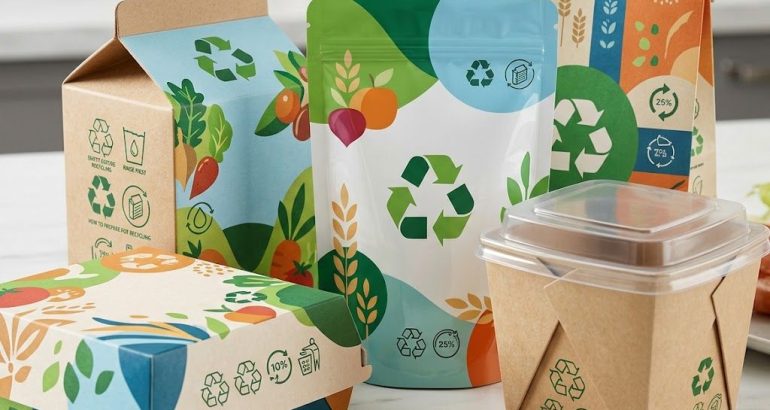
Recyclability claims require verifiable compliance with recognized standards under laws like California’s SB 343 and SB 1335, which govern food service packaging in state-owned facilities. Compostable or biodegradable labels must be substantiated and clearly identifiable, as roughly 60% of consumers actively seek sustainable packaging.
Recyclability claims on custom food packaging require verified compliance with laws like California’s SB 1335 and SB 343, which govern compostability and recyclability labeling. We guide clients through substantiating claims with recognized standards, avoiding vague terms like “biodegradable” without proof, and ensuring labels match actual recycling stream acceptance to reduce contamination and legal exposure.
Why Are Unsubstantiated Recyclability Claims Risky Now?
Vague recyclability and compostability claims carry real legal and financial exposure this year. Regulators have documented years of unsupported labeling that misled shoppers. Increased contamination at composting and recycling facilities, eroding public trust in organics recovery systems. That history is exactly why new state statutes now demand proof, not marketing language, behind every green claim we place on custom printed food packaging.
We built our compliance approach around a simple reality: packaging is no longer a disposable line item. For decades, brands treated packaging as a consumable — ordered, used, forgotten. That mindset fails under current scrutiny. Packaging today functions as a brand touchpoint, an operational tool, and a financial asset tied directly to margins, sustainability goals, and customer experience. A recyclability claim that can’t survive review damages all three at once.
What happens if a recyclability claim can’t be substantiated?
Unsupported claims trigger contamination downstream, since consumers sort packaging based on label promises facilities can’t actually process. That contamination undermines composting and recycling infrastructure broadly, not just for the brand at fault. It also invites enforcement action under sustainable packaging labeling laws now spreading state by state.
Does sustainability messaging affect brand reputation beyond compliance?
Yes. Sustainable practices increasingly shape how packaging gets designed and produced across every industry we serve. Brands that get labeling wrong lose credibility built over years in a single news cycle.
We advise clients to treat label accuracy as inseparable from FTC Green Guides compliance, since:
- Vague terms invite regulatory challenge and consumer complaints
- Contamination penalties fall on brand owners, not just facilities
- Reputational damage often outlasts any fine imposed
What Does FTC Green Guides Compliance Require?
FTC Green Guides compliance requires that any environmental claim on packaging be substantiated, specific, and provable at the point of sale. Vague words like “green” or “eco-friendly” cannot stand alone. A compostability claim must be verifiable under recognized standards and clearly identifiable where the customer actually sees it, not buried in fine print or a corporate sustainability page.
We see this substantiation standard echoed across state law, not just federal guidance. A growing set of sustainable packaging labeling laws across the states is converging on the same principle that has long anchored federal truth-in-advertising rules: if a package looks compostable or claims to be, it has to prove it. That convergence matters for brand managers weighing packaging claims across multiple markets simultaneously.
Why does ink and material choice matter for compliance?
Ink chemistry affects whether a food package can legally carry a compostable or recyclable claim. We produce custom printed food packaging using water-based, odorless inks, engineered to keep materials aligned with applicable food-safety and environmental regulations. That approach protects brands from claims that look strong on shelf but collapse under regulatory review.
Who should brands trust to navigate these rules?
Experience matters more than good intentions here. Founded just outside Philadelphia, our organization has spent decades producing packaging, print, and display solutions for Fortune 500 companies and major national brands.
Compliance-ready packaging typically requires:
- Substantiated, standard-based environmental claims
- Clear, on-package identification of certifications
- Food-safe, regulation-aligned printing materials
- Consistent claims across state and federal frameworks
We build these requirements into production from the first proof, not after a compliance issue surfaces.
How Does California SB 343 Restrict Recyclable Labels?
California sustainable packaging labeling laws hinge on one central rule: a product cannot carry a recyclable claim unless it meets the standards set by SB 343. The Association of Plastic Recyclers provides implementation guidance that helps brands interpret what qualifies. We treat this law as the baseline for every recyclability decision our clients make. Getting it wrong risks fines, retailer rejection, and consumer distrust.
SB 343 rarely operates in isolation. California has layered multiple packaging and labeling requirements over the past several years. Brands need to understand how these statutes interact rather than reading SB 343 as a standalone checklist. We help clients map their labeling claims against this full regulatory landscape before a single label goes to print.
What Should Food Businesses Check Before Printing Recyclable Claims?
Verify that the packaging material and format meet California’s current recyclability thresholds before finalizing artwork. We recommend cross-referencing SB 343 requirements against any other applicable California packaging statutes. Compliance under one law does not guarantee compliance under another.
For custom printed food packaging, this verification step matters even more. Food packaging often combines multiple materials, coatings, or components, and each element can affect whether the finished product qualifies for a recyclable label under state law.
Our production process builds compliance checks into the design phase rather than treating them as an afterthought. That approach includes:
- Reviewing packaging structure against SB 343 recyclability criteria
- Cross-checking claims against related California labeling statutes
- Coordinating custom packaging solutions—food-grade and sustainable formats alike—to fit each client’s specific compliance profile
Brands that skip this coordination often discover problems after packaging is already in the market. We build the verification upfront, so clients avoid costly reprints and label recalls.
What Other Sustainable Packaging Labeling Laws Apply?
State rules extend well beyond compostability claims, and California’s SB 1335 sets one of the clearest examples. This statute requires food service packaging to fit within the state’s existing recycling and composting infrastructure. It also targets contamination, pushing food businesses toward packaging that composting and recycling facilities can actually process without disruption.
For food business owners, brand managers, and packaging designers, SB 1335 signals a broader trend. States increasingly expect packaging to perform as claimed within real-world waste streams, not just on paper.
What does SB 1335 require from food packaging?
SB 1335 pushes for packaging design improvements that protect public health. Wildlife while expanding takeback and reuse options at state facilities. Food service operations that fall under its scope need packaging engineered for compatibility with regional recycling. Composting programs, not generic sustainability language.
Navigating this patchwork of requirements, alongside broader sustainable packaging labeling laws, demands production partners who understand both compliance and manufacturing. We built VT Group as a full-service suite of companies serving the packaging. Innovative design industries, giving brand managers one partner instead of several vendors to coordinate. flexographic plate making
Our capabilities cover the full production chain relevant to compliant packaging development:
- Workflow management
- Flexographic pre-press and plate manufacturing
- Large format digital printing
- Die cutting
- Creative graphic design
This consolidated structure matters for teams producing custom printed food packaging at scale. Rather than managing separate vendors for design, plate-making, and printing, brands work with one accountable source, reducing the risk of compliance gaps between production stages.
Navigating recyclability claims on custom printed food packaging demands rigorous adherence to regulatory standards and substantiated environmental assertions. Brands that prioritize accuracy in labeling—distinguishing between recyclable materials, infrastructure availability, and consumer participation—build trust while mitigating legal exposure. By aligning packaging claims with verified data. Applicable guidelines, manufacturers and converters establish competitive advantage through compliance and transparency, ultimately strengthening market position and consumer confidence.
Frequently Asked Questions
Which California laws govern recyclability claims on food packaging?
SB 343 and SB 1335 govern these claims. SB 343 requires strict substantiation for recyclability labels. SB 1335 mandates packaging fit into existing state recycling and composting systems to reduce contamination.
Why do vague terms like “biodegradable” face scrutiny?
Vague terms lack the proof regulators now demand. Unsubstantiated claims have historically misled shoppers while increasing contamination at composting. Recycling facilities, eroding public trust in organics recovery systems.
What happens when a recyclability claim can’t be substantiated?
Unsupported claims cause contamination downstream because consumers sort packaging based on promises facilities can’t process, undermining recycling infrastructure broadly and inviting enforcement action under state labeling laws.
Conclusion
Legally printable recyclability claims on custom food packaging are those substantiated under SB 343, compatible with SB 1335’s recycling and composting infrastructure requirements, and specific enough to satisfy FTC Green Guides standards. SB 343 anchors California’s recyclable-label threshold, SB 1335 ties packaging design to real-world waste-stream capacity, and FTC Green Guides compliance demands proof over vague terms like “biodegradable” or “eco-friendly.” Together, these standards make substantiated, verifiable labeling the only defensible path for food business owners, brand managers, and packaging designers working across state and federal jurisdictions. If you’re evaluating whether your current packaging claims hold up under this scrutiny, schedule a consultation with VT Group to verify your labeling before it goes to print.