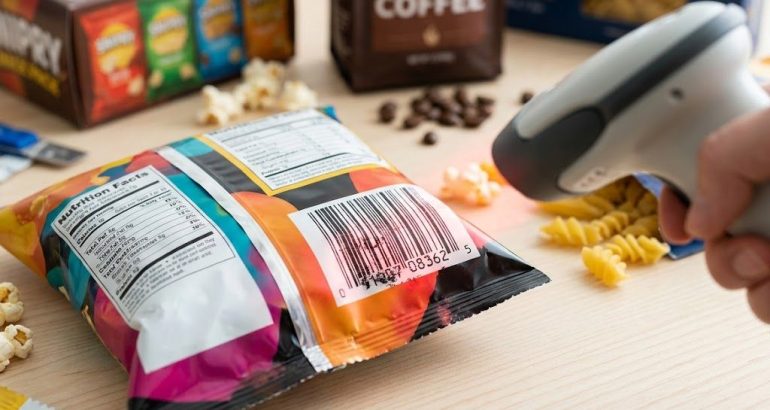
Barcode failures on custom food packaging stem from low print contrast, undersized quiet zones, and substrate glare that block scanners at retailers like Walmart and Amazon. Curved surfaces, ink bleed, and inconsistent plate pressure distort bars further. We correct these variables through press characterization and color management, ensuring every code scans accurately across the full supply chain.
What Do You Need Before Printing Food Packaging Barcodes?
Printing barcodes for food packaging demands preparation long before plates touch a press. A barcode functions as a printed pattern that stores product data in a machine-readable format. Batch numbers, origin, expiration dates. Getting that pattern right on custom printed food packaging requires groundwork across artwork, plate specification, and press setup.
We prepare plates through disciplined press characterization and color management, ensuring barcodes reproduce accurately across every run. This step matters because poor bar-and-space fidelity causes scan rejections at the distribution center, not just the checkout lane.
What information should procurement teams confirm before submitting artwork?
Procurement managers and print buyers should confirm several items before files go to plate production:
- Barcode symbology and data string, verified against UPC scannability requirements
- Minimum bar width and quiet zone dimensions for the substrate
- Color pairing that meets retail barcode print contrast standards between bars and background
- Placement location away from seams, curves, or overwraps
Packaging asset management principles apply directly here: brands need visibility, consistency, and control before production starts, and barcode specification is part of that control.
Does location matter for plate production support?
Location shapes turnaround and communication. As a regional packaging partner, we support barcode-ready plate production for procurement teams. Proximity shortens proofing cycles and simplifies press-side troubleshooting before full production runs begin.
How Do You Verify UPC Scannability Before Printing?
Verification starts with a five-step pre-press checklist that confirms every barcode scans correctly before plates ever touch a press. We run this checklist on every project involving custom printed food packaging. A rejected scan at retail costs far more than a delayed print run.
- Confirm GS1 registration first. Major retailers, including Amazon, Tesco, Carrefour, and Walmart, require GS1-standard barcodes for product acceptance and listing within their systems. We verify GS1 compliance before any artwork moves to plate-making.
- Flag non-standard codes immediately. Using non-GS1 codes risks listing rejection, counterfeit allegations, and blocked access to certain ecommerce channels. Our team catches these issues at the file review stage, not after the run ships.
- Route files through structured workflow management. Consistent quality checks depend on a repeatable process, not a one-off glance at the artwork. Our workflow management protocols apply the same review standard to every SKU, reducing the chance a flawed code slips through.
- Assign project oversight, on-site or remote. Our project management teams confirm barcode compliance across the supply chain before print runs launch, coordinating between brand, converter, and retailer requirements.
- Document the sign-off. A recorded approval at each stage gives procurement teams a clear audit trail if a compliance question arises later.
Who Should Own Barcode Verification Internally?
Procurement managers and packaging engineers share this responsibility in most organizations. Engineers confirm the technical file meets UPC scannability requirements, while procurement confirms retailer-specific listing rules before purchase orders finalize.
Does Print Contrast Affect Scan Verification?
Yes. Scanners depend on retail barcode print contrast between bars and background to read a code accurately. Contrast checks belong in the same pre-press review as GS1 validation. Weak contrast fails scans even when the underlying code data is correct.
How Do You Optimize Retail Barcode Print Contrast?
Optimizing print contrast starts on the press, not at the checkout scanner. Weak contrast between bars and background causes scan rejections at distribution centers. Store registers, delaying shipments and costing brands chargebacks. We correct these issues by controlling the plate-making. Press variables that determine whether a barcode scans on the first pass.
Our plate-making and press characterization expertise directly governs the contrast accuracy that scanners depend on. Color management protocols catch drift in ink density before it reaches finished rolls of custom printed food packaging. We treat contrast control as a production discipline, not a final inspection step.
Follow this sequence to build reliable contrast into a packaging run:
- Confirm bar-to-background contrast targets before plates go to press.
- Characterize the press for the specific substrate and ink combination.
- Monitor color consistency throughout the run, not just at startup.
- Inspect printed barcodes visually before shipment, since print-related failures are typically visible to the eye.
- Flag and correct any drift immediately, rather than after full production completes.
We deploy a single-source technology approach across these steps, which reduces the inconsistencies between plate, press, and substrate that create low-contrast, unreadable codes.
What Causes Poor Barcode Contrast on Packaging?
Barcode failures generally split into two categories: poor printing and poor data quality. Poor printing is the more visible culprit, showing up as smudging, ink starvation, or uneven bar edges that scanners cannot distinguish from the background. Data quality problems, by contrast, hide beneath a clean-looking barcode and require deeper diagnostic checks to uncover.
Why Does Contrast Matter More Than Barcode Size?
Contrast determines whether a scanner’s sensor can distinguish bars from background at all, regardless of barcode dimensions. A properly sized barcode with weak contrast still fails to meet UPC scannability requirements. Scan engines read light reflectance differences rather than physical measurements alone. We prioritize contrast validation before size adjustments in every production run.
What Steps Prevent Barcode Failures on Custom Packaging?
Four disciplined steps prevent most barcode failures: correct placement, complete pre-quote specification, food-safe ink selection, and industry-specific design. We build these steps into every project because a single scan failure at a distribution center delays entire shipments and damages retailer relationships.
Our process follows a defined sequence, starting well before artwork reaches the press.
- Audit barcode placement during proofing. We check that barcodes never sit on curved edges or corners, since scanners struggle to read distorted surfaces. We confirm adequate white space margins around every symbol before approving final art.
- Document full production specifications before quoting. Before requesting a production quote, we specify product behavior, fill weight, material risk, format, and sample approval criteria. Missing details at this stage create rework later.
- Select food-safe, high-contrast inks. We produce custom printed food packaging using water-based, odorless inks that meet regulatory requirements while keeping graphics vivid on shelves.
- Tailor packaging to the client’s industry. Our custom packaging solutions address the specific needs of food, retail, and sustainable packaging clients, so barcode structure and material choice match each product category’s handling conditions.
Why does barcode placement matter so much on food packaging?
Placement determines whether a scanner can even register the symbol. Barcodes positioned on curved surfaces or tucked into corners distort under the optical reader, forcing manual re-entry at checkout or distribution. We flag these positions during proofing, before any run reaches production.
What information should print buyers gather before requesting a quote?
Print buyers should compile product behavior, fill weight, and material risk data ahead of any quote request. Format requirements and sample approval criteria round out the specification, giving our production team what’s needed to protect UPC scannability requirements and maintain retail barcode print contrast from the first proof through final delivery.
What Common Mistakes Cause Barcode Scan Failures?
Scan failures trace back to two root causes: inaccurate data behind the code and poor print execution on the package itself. Treating packaging as a disposable line item, rather than a financial asset tied to margins and customer experience, raises the odds that these errors slip past quality checks and reach retail shelves.
Decades of experience across categories have shown us the same failure patterns repeating. Learn more about our flexographic plate making capabilities. Most originate in one of these areas:
- Data errors: expiration dates, lot numbers, or product origin fields that don’t match what’s printed on custom printed food packaging
- Print quality gaps: ink bleed, low resolution, or substrate texture that distorts bar width
- Placement issues: codes positioned on curves, seams, or folds where scanners can’t get a clean read
Why Do Data Errors Cause Scans to Fail?
Every package must display accurate expiration dates, lot numbers, and origin information for traceability. When that underlying data doesn’t match the printed code, scanners reject the read even if the bars look flawless.
How Does Print Contrast Affect Scanning?
Retail barcode print contrast determines whether a scanner’s laser or camera can distinguish bars from background at all. Low contrast between ink and substrate is a leading cause of rejected scans at checkout and distribution centers.
Meeting UPC scannability requirements demands consistent oversight across design, plate-making, and press output. Our single-source model exists to close that gap, reducing recurring barcode errors and protecting enterprise value for converters, brands, and CPCs alike.
Barcode failures on custom printed food packaging stem from a convergence of design, production, and material challenges that demand precision at every stage. Addressing these issues requires expertise in plate-making, color management, and press characterization—disciplines that distinguish superior packaging manufacturers from standard producers. Organizations committed to eliminating waste and delivering reliable, scannable packaging recognize that quality control and technical proficiency directly impact supply chain efficiency and consumer experience. The investment in advanced solutions pays dividends through reduced errors, faster retail operations, and sustained brand integrity.
Frequently Asked Questions
Why do barcodes fail on custom printed food packaging?
Low print contrast, undersized quiet zones, and substrate glare block scanners at retailers like Walmart and Amazon. Curved surfaces, ink bleed, and inconsistent plate pressure distort bars further, causing rejections at distribution centers.
How does VT Group correct barcode scan failures?
VT Group corrects these variables through press characterization. Color management, ensuring every code scans accurately across the full supply chain. This process confirms bar-and-space fidelity before full production runs begin.
What should procurement teams confirm before submitting artwork?
Teams should verify barcode symbology, minimum bar width, quiet zone dimensions, contrast-compliant color pairing, and placement away from seams, curves, or overwraps. GS1 registration confirmation also happens before plate-making starts.
Conclusion
Barcode failures on custom printed food packaging trace back to a defined set of attributes: print contrast, quiet zone sizing, substrate glare, and plate pressure consistency. Controlling each of these attributes at the pre-press and press stage, rather than catching problems after printing, is what keeps a code scannable at retailers like Walmart and Amazon. VT Group applies press characterization, color management, and GS1-compliant verification to every project so these attributes stay within tolerance before a run reaches production. If your team is preparing a packaging run and wants barcode compliance built in from the first proof, schedule a consultation with VT Group to discuss your project.