Plastic and vinyl printing is how a brand turns a flat design file into a physical object a shopper can walk up to and touch. Plastic printing puts graphics onto rigid sheet like styrene, PVC, acrylic, corrugated plastic, and foam core. Vinyl printing puts them onto flexible media like banners, adhesive window film, and floor graphics. Both run on wide-format digital presses, and the right choice depends less on the artwork than on where the piece has to live and how long it has to last.
For Philadelphia retailers, restaurants, agencies, and property managers, that decision shows up on every storefront, endcap, and lobby wall. This guide walks through the substrates, the durability trade-offs, the ink systems, and the questions worth asking before you send a file to a printer.
Key Takeaways
- Plastic printing covers rigid substrates (styrene, PVC, acrylic, corrugated plastic, foam core); vinyl printing covers flexible media (banners, adhesive graphics, clings). The environment picks the material, not the design.
- Physical stores still carry most retail. E-commerce was only 17.1 percent of total US retail sales in the second quarter of 2026, according to the U.S. Census Bureau, so in-store signs and displays reach the other 82.9 percent of spending.
- Indoor graphics reward low-odor inks. The EPA reports that indoor concentrations of many volatile organic compounds run up to ten times higher than outdoors, which is why water-based and UV-cured inks matter for retail and restaurant interiors.
- Digital printing needs no plates or films, so short runs, regional versions, and design revisions stay affordable.
- With 27,291 printing establishments counted nationwide in the first quarter of 2026, substrate range, in-house cutting, and ink systems are what separate one printer from the next.
What plastic and vinyl printing actually means
Plastic and vinyl printing are two halves of wide-format digital print: one prints on rigid sheet, the other on flexible rolls. Rigid plastic printing lays ink directly onto a solid panel that stands on its own, which is what you want for counter displays, freestanding signage, and structural retail units. Vinyl printing lays ink onto a bendable film that gets applied to a surface or hung in tension, which is what you want for banners, window graphics, and wall murals.
The category sits inside a large and fragmented industry. The U.S. Bureau of Labor Statistics counts about 338,500 people employed in printing and related support activities as of August 2026, spread across 27,291 private establishments in the first quarter of 2026. That scale is good news for buyers, because capability varies widely from shop to shop, and the right partner will print the exact substrate your project needs rather than pushing you toward the one material they happen to stock.
Digital Impact, a VT Group company, prints and converts corrugated, styrene, foam core, and mixed-material builds, and its UV press prints corrugated, plastics, and roll-to-roll media on the same machine. That range is the point: a single job can combine a rigid header, a flexible banner, and a floor graphic and still match color across all three. You can see the full menu of formats on the company’s interior and exterior signage page.
Why plastic and vinyl printing still drives Philadelphia sales
Plastic and vinyl printing still matters because most buying happens in physical space, not on a screen. The U.S. Census Bureau put e-commerce at 17.1 percent of the $1,986.5 billion in total US retail sales for the second quarter of 2026. That leaves nearly 83 percent of spending happening in stores, showrooms, restaurants, and venues, where a printed sign is often the last message a customer sees before deciding.
Printed graphics are the working media of that moment. Point-of-purchase and point-of-sale displays hold a product at eye level, which is the core of Digital Impact’s large-format printing and display work. Window graphics convert foot traffic into walk-ins. Floor graphics route people through a space. Backlit signs and banners set the tone before anyone reads a word. These are the everyday jobs behind retail signage printing, and they work around the clock on every person who walks in.
Done as a system rather than one sign at a time, plastic and vinyl printing becomes the visual layer of a whole space. That larger discipline, from the lobby to the shelf, is what our guide to environmental graphics covers in depth.
Rigid plastic substrates and when to choose each
Rigid plastic substrates differ mostly in hardness, weight, and service life, so match the sheet to the job rather than defaulting to one material. Here is how the common options compare.
| Substrate | Best for | Notes |
|---|---|---|
| Styrene | Counter displays, retail signage | Harder surface and longer service life than foam core |
| Expanded PVC (Sintra-type) | Durable indoor and semi-outdoor signage | Rigid, lightweight, holds paint and print well |
| Acrylic | Premium, backlit, and upscale retail | Optical clarity; pairs with white ink for backlighting |
| Corrugated plastic | Temporary outdoor and event signage | Moisture-resistant and inexpensive for short cycles |
| Foam core | Lightweight interior signage | Ideal for short-cycle promotional work, not outdoors |
Styrene earns its place when a display has to survive weeks of handling, because a harder surface resists scuffing better than foam. Foam core is the opposite call: cheap, light, and quick for a two-week promotion. Corrugated plastic goes outside where moisture would destroy paper-based board. Acrylic is the choice when clarity and a premium feel justify the cost, and it works with white ink so a graphic stays opaque on a clear or colored panel.
Cutting is half the job. Digital Impact runs three Elitron Kombo TAV-R dieless cutting tables, each with two independent heads running at up to 102 meters per minute, which means a rigid panel can be cut to any custom shape without paying for a physical die first. That matters for anyone ordering a short run or a one-off shape.
Flexible vinyl and where it wins
Flexible vinyl wins wherever a graphic has to bend, stick, or hang, which rigid plastic cannot do. Printed banner vinyl covers large spans at low weight for storefronts, events, and trade shows. Adhesive-backed vinyl becomes window graphics, wall murals, and floor graphics. Static and adhesive clings handle temporary promotions that need to come off cleanly.
Not all vinyl is equal, and the split is worth knowing. Cast vinyl films are thin and conformable, so they hug curves and last for long-term outdoor work. Calendered films are thicker and more economical, which suits flat surfaces and shorter campaigns. High-traffic pieces like floor graphics usually get a protective laminate so foot traffic does not wear the print away. Digital Impact lists window graphics, wall graphics, floor graphics, and banners among its interior and exterior signage, and its UV press prints sheet and roll-to-roll media on the same machine.
Indoor versus outdoor: inks, durability, and air quality
The environment decides the ink and the finish before it decides anything else. Outdoors, a graphic needs UV-stable ink, a weatherable substrate, and often a laminate to survive sun, rain, and temperature swings. Indoors, the priority shifts to color, low odor, and how fast a space can be back in use once new graphics are up.
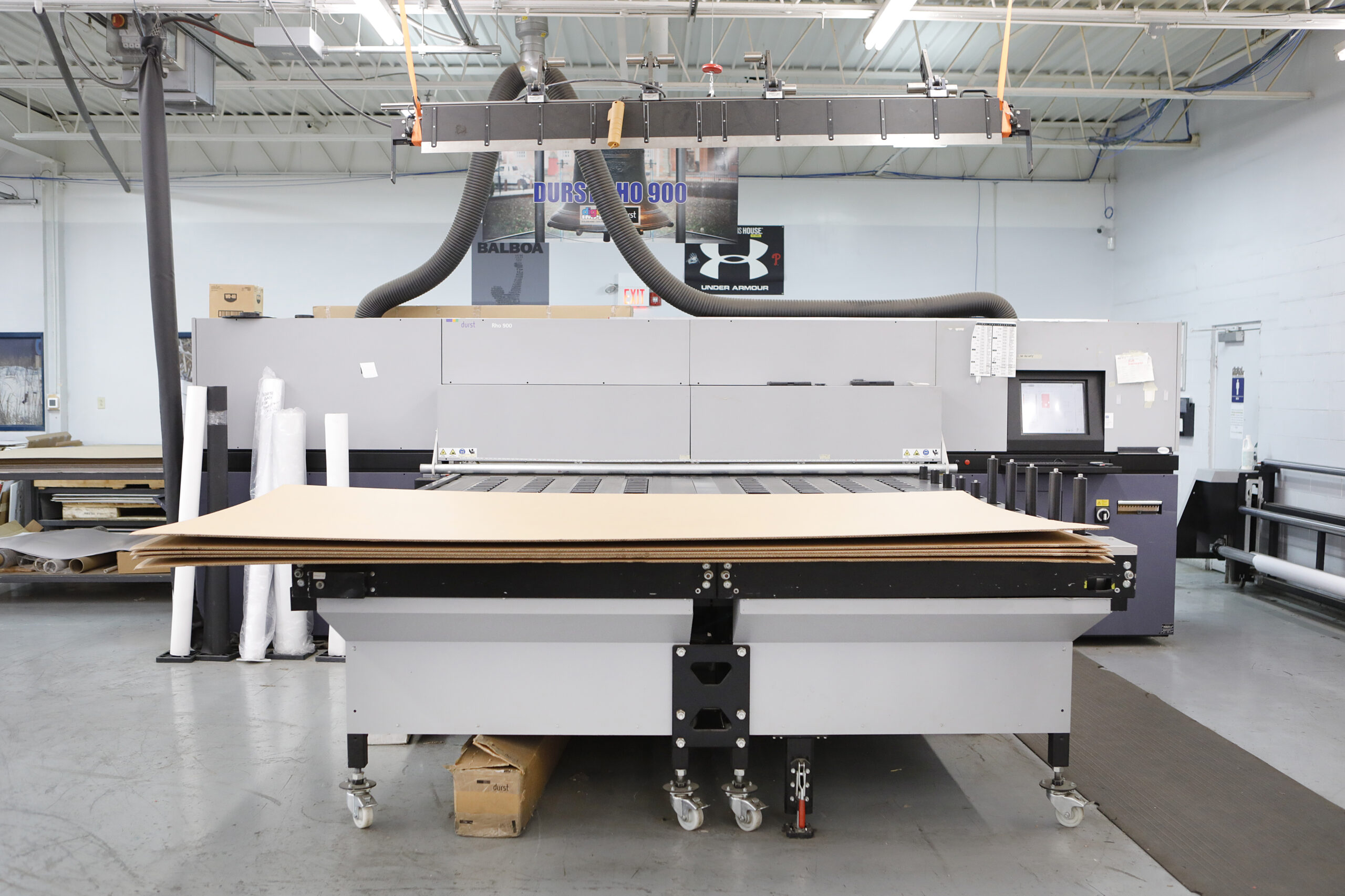
Air quality is a real constraint indoors, not an afterthought. The U.S. Environmental Protection Agency reports that concentrations of many volatile organic compounds run consistently higher inside than out, up to ten times higher, which is why low-emission inks belong in any retail, restaurant, or office interior. Digital Impact addresses this at the press. Its Durst Delta WT 250 uses water-based inks that are odorless, abrasion resistant, and free of hazardous labeling, producing litho-quality prints without the solvents older systems relied on. For jobs that need to print across many surfaces at once, the Durst Rho 900 uses UV-cured ink and a white channel so color stays consistent from a rigid panel to a flexible banner.
How the printing and finishing actually happens
Modern plastic and vinyl printing is digital, which means no printing plates and no films stand between your file and the finished piece. Digital Impact prints on two large-format Durst presses: the water-based Delta WT 250 at up to 1200 dpi with a six-color CMYKcm ink set, and the UV-based Rho 900 at up to 900 dpi with a seven-color set that adds white and prints on almost any substrate, sheet or roll. Finishing runs through the three Elitron dieless cutters and the Esko die cutters on the same floor.
Skipping plates changes the economics in three practical ways. Short runs become affordable, because there is no tooling cost to amortize. A design revision no longer means remaking a plate, so versioning for a single region or chain is cheap. And reprints are quick, because the file is the only setup. You can see the presses and cutters on the printing, cutting, and finishing equipment page, and the same platform prints the corrugated and styrene units covered under corrugated and POP display printing.
On the floor
The two presses and the cutters a Philadelphia panel runs through
Digital means no plates and no films between the file and the finished piece, which is what makes short runs and revisions cheap.
1200 dpi
Durst Delta WT 250, water-based, with a six-color CMYKcm ink set
900 dpi
Durst Rho 900, UV-cured, seven colors including white, on almost any substrate, sheet or roll
3 tables
Elitron Kombo TAV-R dieless cutters, each with two independent heads, so a rigid panel is cut to shape with no physical die
How to choose a plastic and vinyl printing partner in Philadelphia
Choose a plastic and vinyl printing partner by capability, not by the lowest line-item price, because the cheapest quote often hides a narrow substrate range or outsourced finishing. With 27,291 printing establishments counted nationwide, the ones worth shortlisting share a few traits. Ask these questions:
- Substrate range: Can they print both rigid plastics and flexible vinyl in-house, and match color across them?
- Finishing: Do they cut, laminate, and assemble under one roof, or ship your job out for the parts that fail most often?
- Ink systems: Do they offer low-odor water-based ink for interiors and UV-cured ink for mixed-substrate runs?
- Turnaround and versioning: Can they run short regional versions without a tooling penalty?
- Track record: Have they done work at the scale and quality your brand needs?
The VT Group has answered those questions since 1966. Founded near Philadelphia and now operating a 45,000-square-foot facility, it is a collective of four companies, VT Graphics, Digital Impact, Ocean Design Group, and FORTE Interiors, serving brands locally and nationwide. When a project is ready to move, the team can scope substrates and finishing from a single request a quote conversation.
Frequently Asked Questions
What is the difference between plastic printing and vinyl printing?
Plastic printing puts ink on rigid sheet such as styrene, PVC, acrylic, corrugated plastic, or foam core, which stands on its own. Vinyl printing puts ink on flexible film that bends, sticks, or hangs, such as banners, window graphics, and floor graphics. Many projects use both.
Which substrate lasts longest outdoors?
For outdoor durability, weatherable rigid options like expanded PVC and corrugated plastic, or a cast vinyl film with a protective laminate, hold up best. The ink matters as much as the substrate, so outdoor work should use UV-stable inks. Indoor pieces can prioritize low-odor inks and finish over weather resistance.
Do you print on clear or colored plastic?
Yes. Printing on clear or colored panels usually calls for a white ink layer so the graphic stays opaque and colors read true. Digital Impact’s UV press includes a white channel for exactly this reason, which is common for backlit acrylic and window work.
Is digital printing cost-effective for short runs?
Digital printing is well suited to short runs because it needs no plates or films, so there is no tooling cost to spread across the order. That also makes design revisions and regional versions affordable, which plate-based processes struggle to match on small quantities.
Can one printer match color across plastic and vinyl in the same project?
Yes, when the printer runs both substrates on the same platform. Digital Impact prints plastics and roll-to-roll media on its UV press, so a rigid header, a flexible banner, and a floor graphic in one campaign can share a single color output.
Sources
U.S. Census Bureau, Quarterly Retail E-Commerce Sales, second quarter 2026, retrieved 2026-09-27. U.S. Bureau of Labor Statistics, Printing and Related Support Activities (NAICS 323), employment August 2026 and establishments first quarter 2026 (preliminary), retrieved 2026-09-27. U.S. Environmental Protection Agency, Volatile Organic Compounds Impact on Indoor Air Quality, retrieved 2026-09-27. Equipment, substrate and company details from VT Group’s own equipment, corrugated display printing and signage pages, retrieved 2026-09-27.