A corrugated quote usually carries a board spec on one line: 32 ECT B flute, C flute double wall, 200 lb test. That line decides how much the box or display costs, how much weight it holds and how the printed panel looks under store lighting. It is also the line nobody explains.
The board is settled before anything is printed. VT Group’s Types of Boxes page covers the styles a box is cut and folded into. This covers the material underneath them: what a flute is, which profile suits a shipper and which suits a display panel, what the strength rating on the certificate actually measures, and what to hand a supplier so the quote comes back on the right board.
Key Takeaways
- A flute is the wave of paper glued between two liners. The arch carries the load and the outer liner takes the print.
- The letters record the order the profiles were introduced, not their size. C flute is taller than B flute, and A flute is taller than both.
- Finer flutes print better and heavier flutes hold more weight. That trade-off settles most board arguments on a retail display.
- The box maker’s certificate states one of two ratings, a burst figure or an edge crush figure, and the two predict different failures.
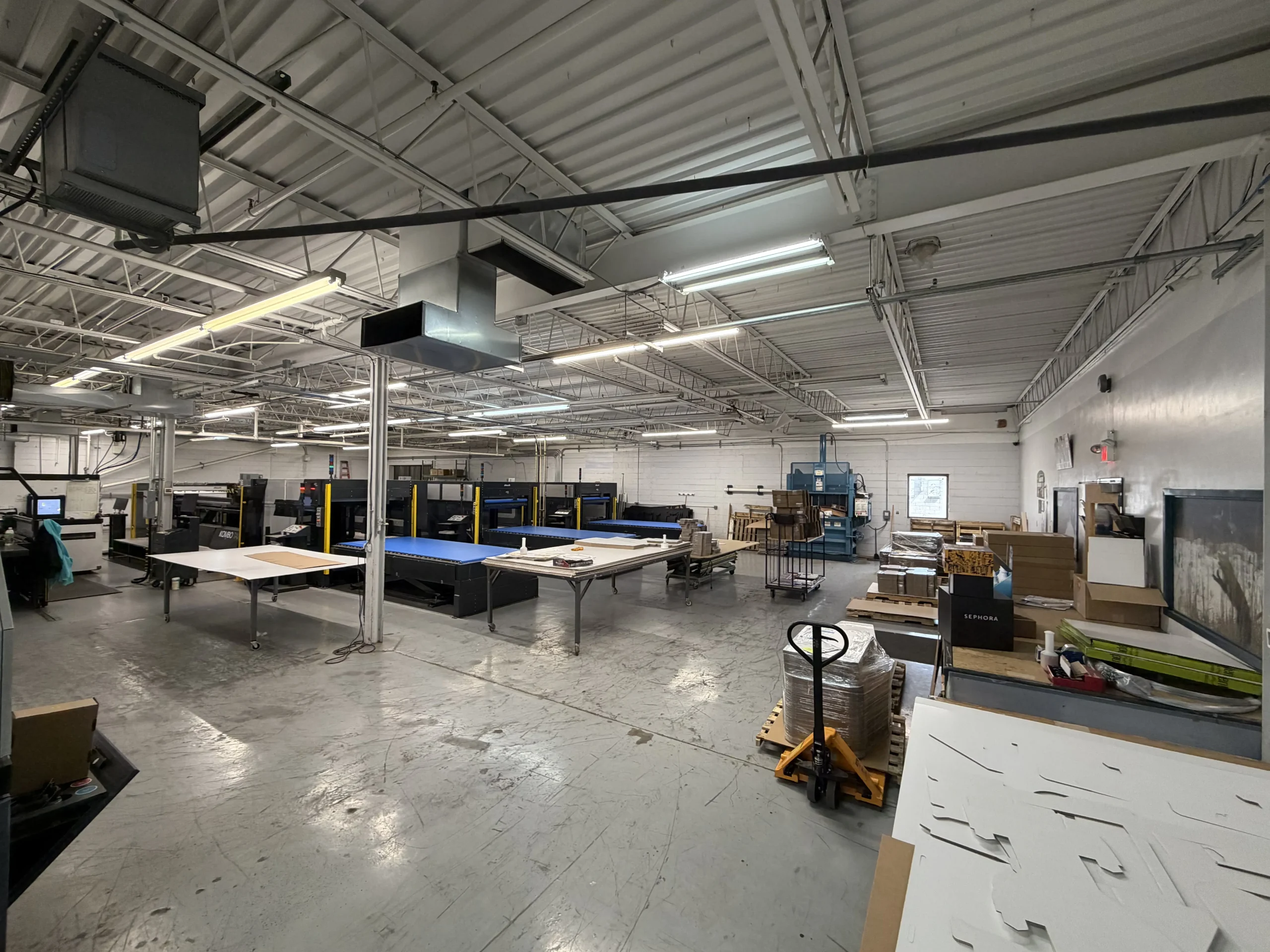
- Digital Impact prints corrugated from lightweight promotional stock through heavier structural grades, and die cuts it in house on three Elitron Kombo TAV-R cutters.
What a flute actually is
Corrugated board is three layers doing three jobs. A sheet of paper is run through fluting rolls until it holds a wave, and that fluted medium is glued between an inner and an outer liner. The wave is the structure: each arch resists a load pressing down on the edge of the board, the way a row of arches holds up a bridge deck. The liners hold the arches in position and give the sheet its printing and gluing surface.
That is why the same box can be strong in one direction and weak in another. Stood on its edge with the flutes running vertically, the board carries a stack. Laid flat, the same sheet crushes under a fraction of that load. It is also why a crease that runs across the flutes behaves differently from one that runs along them, which is a structural decision taken on the drawing rather than on the press.
Profiles are named with letters, and the letters are the first thing to get past. They record the order the profiles were introduced, not their relative size. A flute came first and is the tallest of the common profiles. B flute came next and is much flatter. C flute arrived later and sits between the two. Read the letter as a name, not a ranking.
Board specification
Flute height, tallest to finest
Approximate height of the fluted medium in standard US profiles. The letters are names, not sizes: C sits between A and B.
A flute
3/16 in
C flute
5/32 in
B flute
1/8 in
E flute
1/16 in
F flute
1/32 in
Flute heights: standard US profiles as published in the Wiley Encyclopedia of Packaging Technology. Treat them as nominal — caliper varies between mills and with the papers used.
The five profiles, and what each one is for
Height is the whole story. A taller flute puts more air and more paper depth between the liners, which buys cushioning and stacking strength. A shorter flute gives a flatter, better supported printing surface and a board that folds into smaller, neater packages.
- A flute — the tallest common profile. Most cushioning and the most depth for stacking, on the bulkiest board. Used where the contents are light relative to their size and the box has to survive being stacked.
- C flute — the general shipping board. It gives up a little cushioning against A flute and prints better, which is why it is the default for a shipper that also has to look presentable.
- B flute — flatter and more rigid against crushing on the panel face. It is the common choice for displays, trays and retail-ready cases, where the board is cut into shaped parts and the printed face is on show.
- E flute — thin board with a surface close to folding carton stock. Used for retail packaging that needs fine print and tight creases while keeping the strength of corrugated.
- F flute — the finest of the group, for small retail packs where the package should read as a printed carton rather than a corrugated box.
Profiles also get combined. Pairing a taller flute with a finer one in the same board gives you load from the first and print surface from the second, which is the usual answer when a single profile cannot do both.
Single wall, double wall, triple wall
Wall count is the second half of the spec, and it is simply how many fluted layers are in the sheet.
- Single wall — one fluted medium between two liners. Most boxes, most displays, most of what ships.
- Double wall — two fluted mediums and three liners, usually two different profiles glued together. The step up for heavy contents, deep stacks and display bases that carry product weight.
- Triple wall — three fluted mediums. Industrial loads and bulk containers. Carrier rules rate it by puncture rather than by the burst test used on thinner board.
Double wall is not automatically the safe answer. It costs more, it adds caliper that every crease and every slot has to accommodate, and it makes a display heavier to ship and harder for a store associate to set up. A single wall board with the right profile and the right rating usually beats a thicker board chosen out of caution.
The number on the box: edge crush or burst
Printed on the bottom flap of most shipping boxes is a circle of small type called the box maker’s certificate. It names the manufacturer and states the board’s rating, and that rating comes from one of two tests.
The burst test, usually called Mullen, measures the pressure needed to rupture the facing of the board. It describes resistance to puncture and to rough handling — a corner taking a hit, a forklift tine, a dropped carton.
The edge crush test, written as ECT, measures how much edgewise compression a short piece of board takes before it collapses. That is the property that predicts how a box behaves at the bottom of a stack, so it is the number that matters when cases are palletized or a display base carries the units above it. The procedure is TAPPI method T 811.
Both are recognized by the freight rules that govern boxes in transit: Item 222 of the National Motor Freight Classification for truck, and Rule 41 of the Uniform Freight Classification for rail. Burst strength with a combined basis weight was the original basis. ECT was added as an alternative in the early 1990s, which is why older specs read as 200 lb test and newer ones as 32 ECT.
Conversion charts pair those two, and they are a useful starting point, but they are not an equivalence. One test describes rupture and the other describes collapse. If your risk is stacking, ask for an ECT value. If it is handling and puncture, ask for a burst value. If a quote changes from one basis to the other, that is a change worth a question rather than a footnote.
Board choice on a retail display
A display is where board decisions get caught out, because the same sheet has to be structural and photographic at once. VT Group’s corrugated display printing page puts the problem plainly: a display ships flat, gets assembled by someone who has never seen it before, and then stands unattended in a store for weeks. Flute selection decides how much load the shelf carries and how the print surface looks. Finer flutes print better, heavier flutes hold more weight.
In practice that pulls a floor display in two directions. The base, the risers and the shelves carry product for the length of a promotion, which argues for a heavier board. The header and the face panels are the graphic the shopper actually sees, which argues for a finer one. A display built from more than one board, or from more than one material, is often how both get answered: Digital Impact prints and converts corrugated from lightweight promotional stock through heavier structural grades, along with styrene, foam core and mixed material builds.
The other half of the question is transit. Shipping performance for point of purchase displays is tested to ISTA procedures, and a display that arrives crushed has failed before a shopper ever sees it. As that page says, a manufacturer who cannot tell you which flute they are quoting, or how the display was tested to survive transit, is quoting on price alone.
How the board meets the print and the cut
Board choice reaches the pressroom as well as the warehouse. On corrugated, the flute structure under the liner creates uneven support, so ink density can vary along the flute pitch — the striped effect known as washboarding. It is most visible on coarse profiles under heavy solids, and plate design, plate gauge and impression pressure are the levers against it. VT Group’s plate making work exists partly to manage that.
Printing without plates changes the arithmetic. Digital Impact’s display process requires no films or plates and uses environmentally friendly inks, so a short run on an unusual board does not have to carry tooling cost before the first sheet prints. The company specializes in short-run work of one to 3,000-plus pieces, which is the range where board experiments and regional versions are normally priced out.
Cutting sets a hard limit that a spec sheet rarely mentions: the board has to fit the tool. Digital Impact cuts and creases on three Elitron Kombo TAV-R cutters, which Elitron rates to cut and crease material up to 20 mm, about three quarters of an inch. That covers heavy single wall, double wall and the rigid boards used in mixed material displays, and because the table follows the structural file, a board change means a new file rather than a new steel-rule die.
What to give a supplier so the quote is right
Most board questions answer themselves once the supplier knows the job. Send these together, and the first quote is usually the one you can buy from.
- Inside dimensions, length by width by depth, and what goes in the package.
- Contents weight, and whether the packages stack — how high, and for how long.
- How it travels: parcel, LTL, full pallet, store delivery, or all of them in sequence.
- The rating you need, as an ECT or burst value, or the performance you want the supplier to hit if you do not have one.
- Run length and versions, because quantity and the number of regional or retailer variants decide the print process before anything else does.
- Print detail: coverage, number of colors, and any brand color that has to match packaging printed elsewhere.
- The structure, as a dieline or a sketch, and the box style if you already know it.
If the job is a package rather than a display, product packaging is where that conversation starts. If you want to judge board by hand rather than by letter, VT Group sends a free sample kit — feeling the difference between a B flute display panel and a C flute shipper takes about four seconds and settles the argument faster than a chart.
Frequently Asked Questions
Which flute is best for a retail display?
There is no single answer, because a display has load-bearing parts and printed parts. Finer profiles such as B and E give the flatter, better supported surface that large printed graphics need. Taller profiles and double wall give the stacking strength a base or a shelf needs. Many display programs use more than one board for that reason, and the structural design decides which part gets which.
Is C flute stronger than B flute?
C flute is taller, so it offers more cushioning and more depth for stacking. B flute is flatter and more resistant to crushing on the face of the panel, and it prints better. Which one is “stronger” depends entirely on how the board fails in your application: by collapsing under a stack, or by being crushed and scuffed on the surface.
What is the difference between ECT and burst strength?
Edge crush measures the edgewise compression the board withstands before it collapses, which relates to stacking. Burst, or Mullen, measures the pressure needed to rupture the facing, which relates to puncture and rough handling. Freight rules accept either basis, and the box maker’s certificate states whichever one the board was certified to.
When do I need double wall board?
When the contents are heavy, when boxes are stacked deep or stored for a long period, or when a display base carries significant product weight. It costs more and adds thickness that the creases and slots have to accommodate, so it is worth asking whether a single wall board with a higher rating does the job first.
Can any flute be printed digitally?
Digital printing is more tolerant of board variation than printing from plates, because there is no plate to make and no tooling to amortize across a long run. The flute still affects the result: finer profiles give a flatter surface and a cleaner solid. The practical gain is that a short run or a one-off version on a specific board does not have to carry a tooling cost first.
Where is the flute written on a box?
It usually is not. The box maker’s certificate gives the manufacturer and the strength rating, not the profile. The flute and wall construction live on the specification you agreed with the supplier, which is the document to keep with the dieline and the approved artwork.
Specifying board for a new carton, shipper or retail display? Send the display or packaging requirement with the contents weight, how it ships and the run length, or contact VT Group in Lansdowne, Pennsylvania, and the team will come back with a board, a build and a schedule.