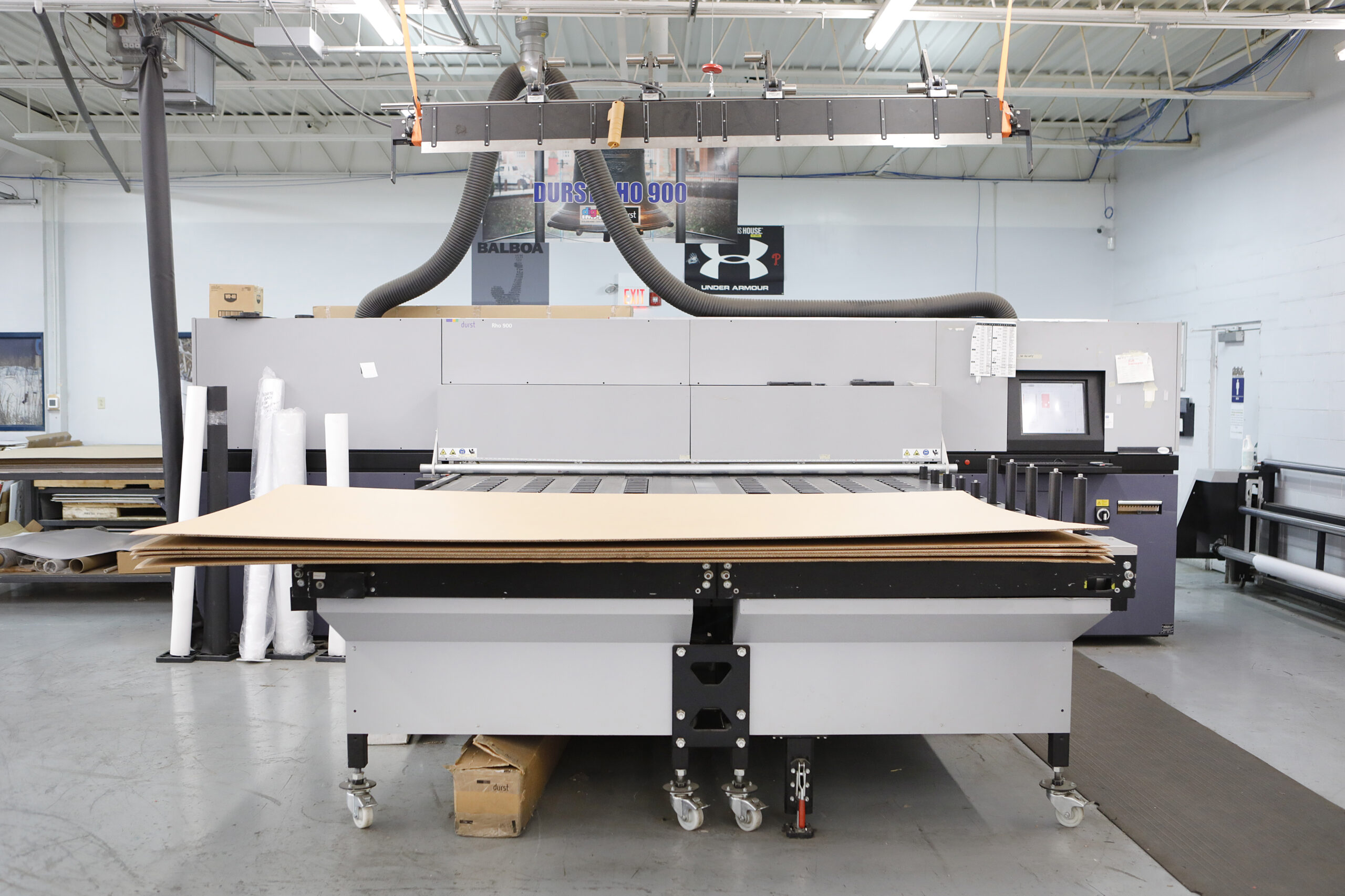
A display program rarely stays still. The retailer asks for a taller header. Marketing adds a regional version. Then a buyer wants a working prototype by Friday. With a traditional steel-rule die, each of those changes starts the same way: new tooling gets built before a single sheet is cut, and the schedule waits.
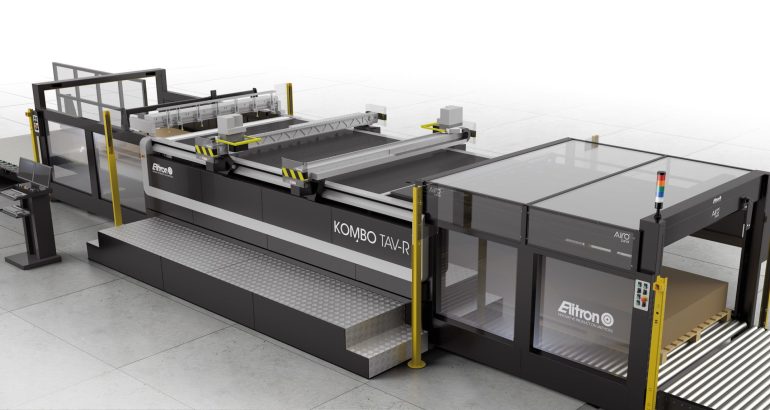
Digital die cutting skips that step. A computer-controlled flatbed follows the structural design file with knives and creasing tools, so a revision means a new file rather than a new die. VT Group’s Digital Impact team does this work on three Elitron Kombo TAV-R cutters, a machine Elitron markets as the only plotter with two independent cutting heads, with a listed top speed of 102 meters per minute.
What follows covers how the process works, what the TAV-R adds, why we now run three, and where it earns its keep on corrugated displays and packaging.
Key Takeaways
- No die, no tooling wait: a digital cutter cuts and creases straight from the design file.
- The Kombo TAV-R runs two independent multi-tool heads at once over a table up to 3,200 by 2,200 mm.
- Top speed: 102 m/min, per Elitron’s catalogue.
- VT Group added a second machine in September 2022 after the first reduced production times and costs, and now operates three.
- Smithers estimates digitally printed packaging and labels at $22.0 billion in 2025, rising to $36.9 billion by 2030, so finishing has to keep pace with digital presses.
What is digital die cutting?
Digital die cutting means cutting, creasing and scoring packaging or display parts without a physical die. A flatbed table reads the structural file and drives its tools along every cut and fold line. That’s the whole trick. The same table can switch from a one-off prototype to a production run with no tooling to make, store or scrap.
Conventional die cutting depends on a steel-rule die: a board fitted with steel blades bent to the outline, then pressed through the material. Once it exists, it’s quick and economical, which is why long runs of an unchanging carton still suit it. The catch is the die itself. Someone has to design, build and approve it first, and any structural change means starting over. So the difference shows up on work that changes: seasonal displays, retailer-specific versions and first prototypes all punish tooling, while a digital cutter treats each one as another file in the queue.
| Digital die cutting | Steel-rule die cutting | |
|---|---|---|
| Tooling | None, cuts straight from the design file | A custom die built for each design |
| Design changes | Update the file | Build and approve a new die |
| Time to first cut | As soon as the file is approved | After the die is made and approved |
| Best fit | Prototypes, short runs, versions, complex shapes | Long runs of an unchanging design |
What is the Elitron Kombo TAV-R?
Italian manufacturer Elitron builds the Kombo TAV-R, a fully automatic cutting plotter for packaging and display production. Loading, camera registration, cutting and unloading happen in one line. Elitron markets it as the only plotter with two independent cutting heads, and the only one that arrives ready for a fully motorized roller loading system.
A note on names: Elitron’s own materials, and our 2023 post, use both “Kombo TAV” and “Kombo TAV-R” for this machine. We say TAV-R.
| Feature | Elitron specification | What it means on the job |
|---|---|---|
| Cutting heads | 2 independent multi-tool heads | Both heads work the table at the same time |
| Cutting area | Up to 3,200 by 2,200 mm (about 126 by 87 in) | Large display panels fit on the table |
| Material thickness | Cuts and creases up to 20 mm (about 3/4 in) | Heavy corrugated and rigid boards |
| Cutting speed | Up to 102 m/min (about 335 ft/min) | Less time per sheet on long cut paths |
| Registration | Seeker System dual-camera vision | Cuts line up with the printed graphics |
| Unloading | Airo Panel suction unloading onto a pallet | Finished sheets come off in one move |
Speed comes from Elitron’s 2017 cutting-tables catalogue (Spanish edition, posted by distributor Sinergia Visual in 2018), and it matches the figure on our own printing, cutting and finishing equipment page. Everything else appears on Elitron’s current product page. Treat all of it as manufacturer maximums; material, tooling and cut-path complexity decide real throughput.
How do two independent cutting heads speed up production?
Two heads let one machine work on two parts of a job simultaneously. Both are multi-tool units that range over the entire cutting area, and Elitron’s TwinCut software calibrates each job and splits the workload between them to shorten overall cutting time.
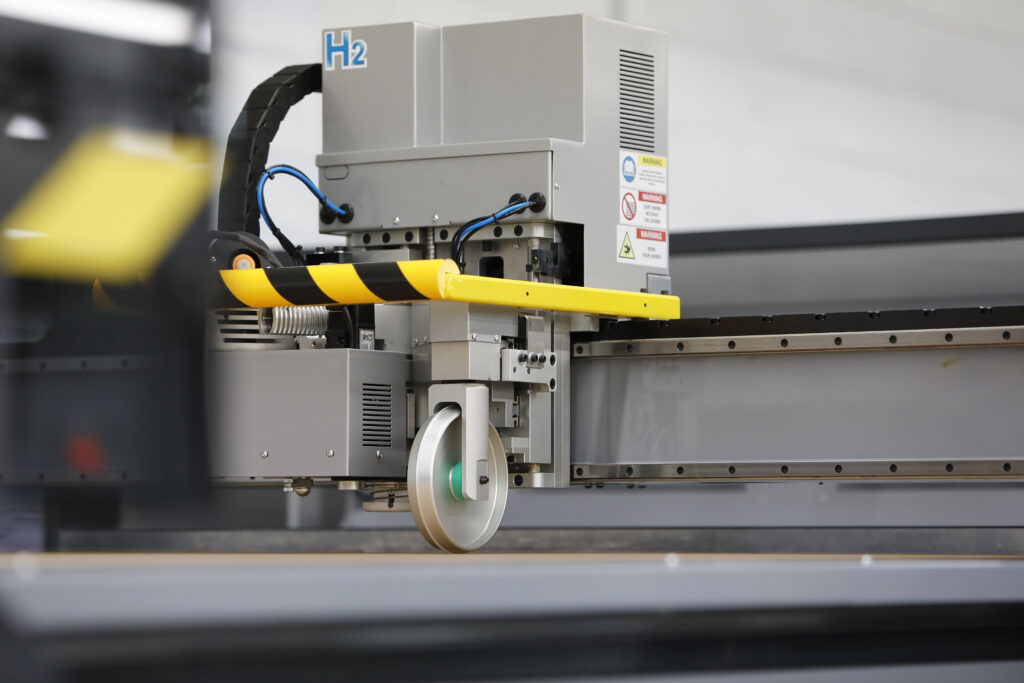
Picture a single-head table. One carriage must travel every cut line on every sheet. Hand that path to two independently moving heads and you’ve opened a second checkout lane: the queue remains, yet it moves faster. Tool variety matters too. The head that traces a panel’s outline can also crease its folds, so a carton or tray leaves the table ready to fold instead of heading to another process.
From pallet to pallet: loading, registration and unloading
The TAV-R loads, registers and unloads sheets automatically. Its multi-sheet loader takes up to 120 cm (about 47 in) of material, fed by lifting table, carriage or roller conveyor, and the system can rise to accept a pallet up to 1,380 mm (about 54 in) high. Meanwhile, a pre-loading area stages upcoming sheets and prepares their registration while both heads keep cutting.
Registration runs itself.
A patented dual-camera Seeker System locates reference marks on each sheet so cuts land on the print, and it reads barcodes or QR codes to call up the matching cutting file. When sheets carry those codes, nobody has to reprogram the table between jobs.
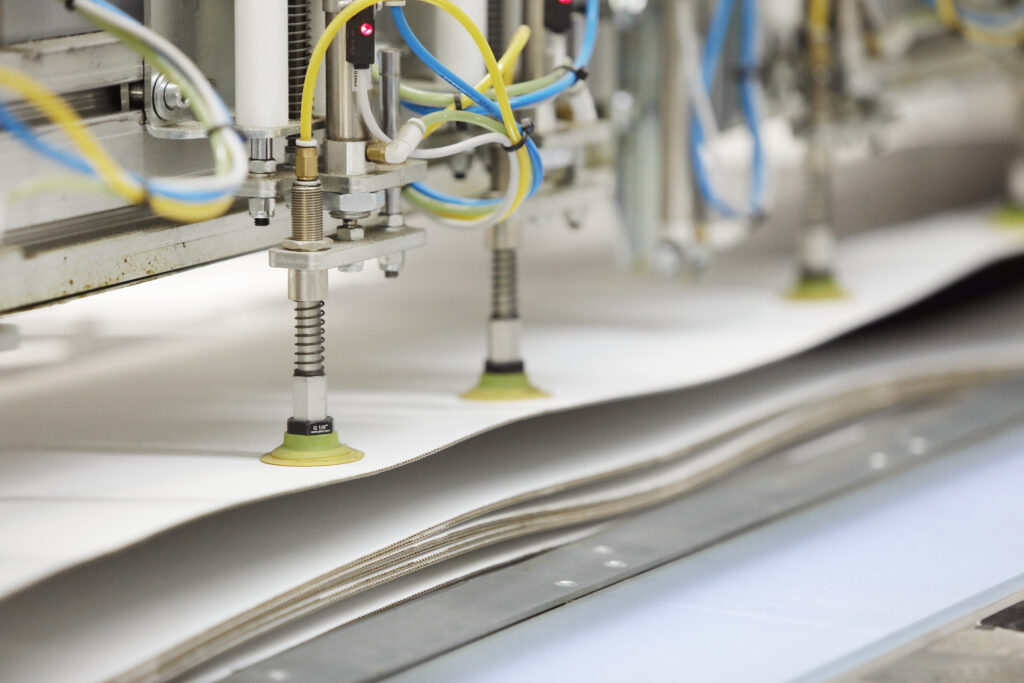
At the far end, the patented Airo Panel lifts every finished sheet off the cutting area in one move, carries the load to the unloading zone and stacks it on a pallet. Elitron calls its fully automated setup “a real 24/7 production without operator.” That’s the manufacturer describing what the equipment can do, not a statement about how our floor is staffed.
Why VT Group runs three Kombo TAV-R die cutters
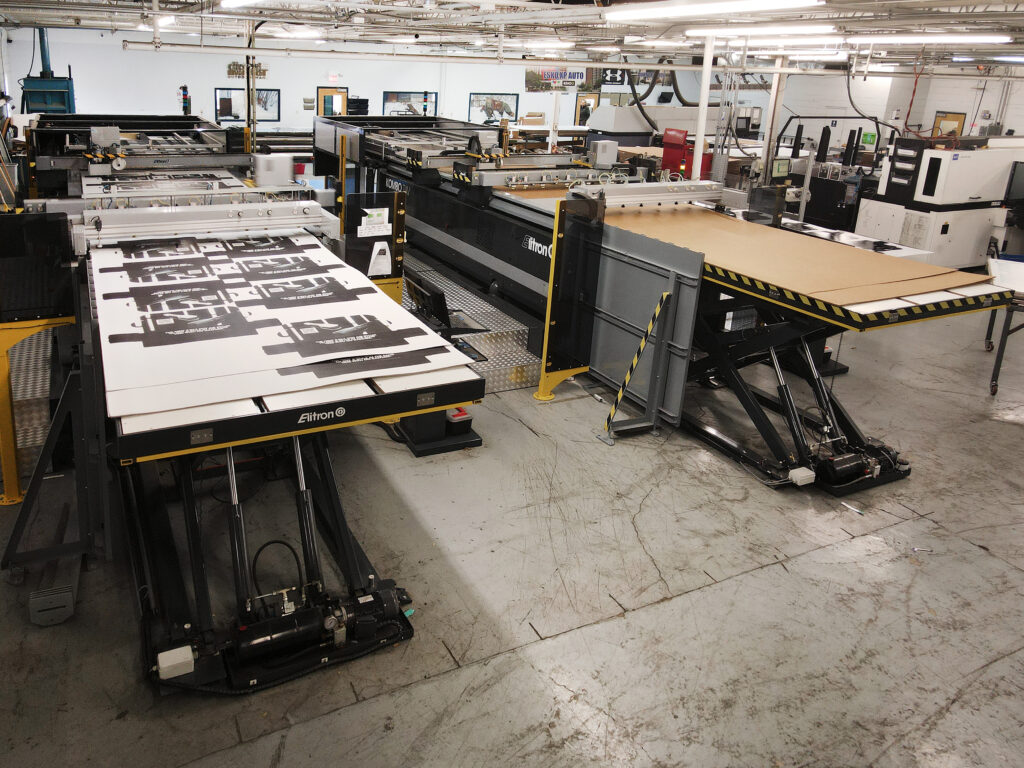
VT Group’s three Kombo TAV-R cutters grew out of what the first one did for production. After our first Elitron cutter went in, as we wrote in 2023, we “saw a significant reduction in production times and costs.” That result led us to install a second machine in September 2022, and the third continues what our equipment page calls our “investment in advanced cutting technology.”
VT Group cutting capacity
Three Kombo TAV-R die cutters, six independent heads
What our Digital Impact team cuts on, per Elitron's published specifications
Sources: VT Group equipment page; Elitron Kombo TAV-R product page and cutting-tables catalogue
More tables also mean more cutting capacity, so a large corrugated display program and a rush prototype are less likely to queue behind each other for the same machine.
Which jobs is digital die cutting best for?
Short runs, changing designs and complex shapes are where a dieless cutter pays off. Think prototypes and samples, regional or retailer-specific display versions, seasonal promotions, and personalized packaging like influencer kits, where each kit can be customized.
Material counts as much as quantity. Our Digital Impact team prints and converts corrugated, styrene and foam core, mixed-material builds included, and Elitron rates the TAV-R for cutting and creasing up to 20 mm thick. On a display, precision is structural. As our corrugated display page puts it, die cutting and scoring determine whether a store associate can assemble it without instructions or damage it trying.
Steel-rule dies haven’t disappeared.
A very long run of a carton that never changes can justify building one. For anything that evolves, from a first prototype to custom product packaging that gets revised between runs, cutting from the file keeps the structure flexible.
How does digital cutting work with digital printing?
At Digital Impact, both steps run from files. Our corrugated printing needs no films or plates, and the TAV-R cutters need no dies, so a revised design can travel from approved file to finished display without new tooling at either stage. One of those presses is a Durst Delta WT 250 water-based corrugated press, the first unit of its corrugated printer class with an enhanced drying system to be installed outside Europe. That pairing matters because digital print only pays off on short runs when finishing keeps up.
Market data points the same way. In research reported by the Flexographic Technical Association in November 2025, Smithers estimated the global market for digitally printed packaging and labels at $22.0 billion in 2025 and forecast $36.9 billion by 2030, a 10.9 percent compound annual growth rate. It named corrugated the most significant opportunity, with digital value there more than doubling to $8.2 billion in 2030. Digital remains a small slice, though: 1.3 percent of printed packaging by volume and 4.1 percent by value, according to the same research. Most packaging still runs on analog presses. That leaves a plain gap for a print-and-cut workflow: jobs too short, too varied or too urgent for plates and dies.
Frequently Asked Questions
What is an Elitron Kombo TAV-R?
It’s a fully automatic digital cutting plotter made by Italian manufacturer Elitron for packaging and display work. It pairs two independent multi-tool cutting heads with a cutting area up to 3,200 by 2,200 mm, camera registration, and automatic loading and unloading. VT Group runs three.
How fast is the Elitron Kombo TAV-R?
Elitron’s catalogue lists a top cutting speed of 102 meters per minute (about 335 feet per minute), and its two heads can cut at the same time. That’s a manufacturer maximum; actual throughput depends on the material, the tools in use and how complex the cut path is.
Is digital die cutting cheaper than steel-rule die cutting?
On prototypes, short runs and designs that change, a digital cutter avoids the cost of designing, building and storing a die, which often makes it the more economical route. On very long runs of an unchanging design, a steel-rule die can win once its tooling cost is spread across enough pieces.
What materials can the Kombo TAV-R cut?
Elitron rates the TAV-R to cut and crease materials up to 20 mm thick for packaging and display production. Our Digital Impact team prints and converts corrugated, styrene and foam core for displays and packaging, including mixed-material builds.
Why does VT Group run three Kombo TAV-R die cutters?
Our first Elitron cutter significantly reduced production times and costs, so we added a second in September 2022 and have since grown to three as part of our investment in advanced cutting technology. The extra tables add cutting capacity, so large display programs and rush prototypes are less likely to wait on the same machine.
Plan your next display or packaging run
Digital die cutting makes the most sense when a project has to change quickly without new tooling each time. VT Group has helped brands bring their products to life since 1966. Planning a corrugated display, a short packaging run or a prototype? Request a free sample kit to judge our print and finishing quality in hand, or contact VT Group at 465 Penn Street, Lansdowne, PA 19050, (610) 259-4090.
Sources
- Elitron, Full Automatic Cutting Plotter KOMBO TAV-R, retrieved 2026-09-14.
- Elitron, 2017 cutting-tables catalogue, Spanish edition (posted in 2018 by Elitron’s Spanish distributor, Sinergia Visual), retrieved 2026-09-14.
- Flexographic Technical Association, Corrugated, Flexibles Drive $22 Billion Digital Print for Packaging Market, reporting Smithers data, November 14, 2025, retrieved 2026-09-14.
- VT Group, Printing, Cutting and Finishing Equipment, retrieved 2026-09-14.